


The political history of the American welfare state is largely a history of targeting. Programs designed for specific populations, defined by need, race, family status, disability, or age, fragmented into silos that serve each group partially and none of them well. The result is a system that provides means-tested scraps to those who can navigate its complexity, while leaving millions who need help but do not fit the right category with nothing.
This series examined the mechanics of means-testing in detail in the welfare article, but the core problem bears repeating here: means-tested programs are simultaneously leaky and exclusive. They pay benefits to some people who could get by without them, because the verification systems are imperfect. They deny benefits to many people who desperately need them, because the paperwork, the interviews, the documentation requirements, the shame, and the sheer administrative weight of proving eligibility defeat people who are already struggling. TANF reaches only about 20 percent of eligible families. The other 80 percent qualify on paper and receive nothing.
The job guarantee is a universal program. It does not ask about your income, your assets, your family structure, or your history. It offers employment to anyone willing to work. This universalism is not incidental to the program. It is its most important political and moral feature.
The Politics of Universal Programs
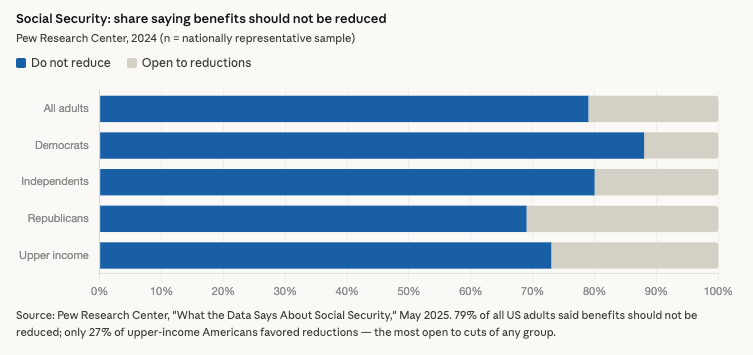
Universal programs are more durable than targeted ones, and the polling data is unambiguous about why. A Bipartisan Policy Center survey conducted on the 90th anniversary of Social Security found that Americans across the political spectrum consider it the most valuable federal program in the country. Pew Research finds that most US adults say Social Security benefits should not be reduced in any way — a view shared broadly across ages, racial groups, partisan affiliations, and income levels. Gallup finds that nearly four in ten Americans worry Medicare and Social Security will not be around in ten years, and that concern is making them more protective of the programs, not less. The federal minimum wage, also universal in its application, consistently polls at 70 percent support or above.
SNAP and TANF, targeted at the poor, are perpetually on the chopping block, stigmatized as giveaways to the undeserving, stripped of funding in every round of budget negotiations. Social Security and Medicare, despite decades of pressure, survive. The politics of universalism produce different outcomes than the politics of means-testing, and that is not accidental. Programs that everyone uses are programs that everyone defends.
Universalism also changes who is in the room when the program is designed and administered. Targeted programs for the poor tend to be designed and administered with the priorities and aesthetics of those who will never use them. Universal programs, used by the full range of the citizenry, are administered with more dignity and more competence because the people with the most political power are inside the tent.
Watch What Happens When Universalism Is Attacked
The Senate Budget Committee held a hearing on March 25, 2026, titled “Social Security: A Discussion on the Facts and the Path Forward.” Among the Republican proposals on the table: raise the retirement age to 69, and reduce benefits for workers earning above roughly $80,000 per year. That second proposal is means-testing with different vocabulary. It targets benefits away from workers who are deemed wealthy enough to manage without the full amount.
The Republican Study Committee has repeatedly advanced this kind of restructuring. The stated rationale is fiscal sustainability. The practical effect, as the political history of means-tested programs makes clear, is to make the program less universal, less popular, and ultimately less defensible. This is a well-documented political strategy: introduce income or wealth thresholds for a universal program, narrow the coalition that depends on it, and wait for the next budget cycle in order to cut, kill, or privatize it.
(It is worth noting that Social Security’s trust fund structure is a feature of how the program was politically designed in 1935, not an operational necessity. Medicare Parts B and D, which cover outpatient care and prescription drugs, face no equivalent trust fund problem because they are funded directly through general appropriations. Congress could make the same choice for Social Security with a single vote. The solvency problem is real within the current structure, but the current structure is a political choice, not an economic law of nature. The drive to means-test is a solution to a problem that has simpler solutions, and one that happens to serve the political goal of narrowing who the program serves to make privatization more politically feasible.)
Predistribution
The preferred term among economists who study labor markets and inequality is predistribution: structuring the economy so that market outcomes are fairer before the tax-and-transfer system ever gets involved. A job guarantee that provides a living wage floor predistributes income to the bottom of the labor market by raising the terms on which all employment is offered. It does not wait for workers to earn poverty wages and then attempt to supplement them through a patchwork of means-tested programs. It changes the baseline.
The means-tested welfare article in this series documented the TANF application process: two interviews at two locations, fingerprinting, a home visit, a mandatory orientation, and thirty days of documented job search before a single dollar is approved. A system that puts that much energy into determining who deserves help is a system designed to not help very many people. A job guarantee puts that energy into doing the work instead.
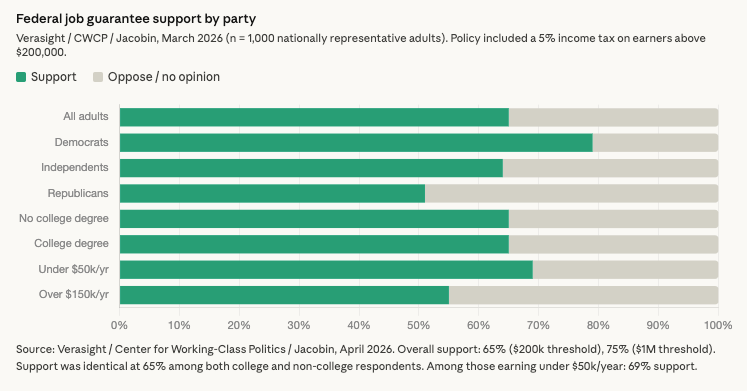
And the public agrees. A March 2026 survey by Verasight, conducted for the Center for Working-Class Politics and Jacobin, asked Americans about a federal job guarantee that included an explicit financing mechanism — a 5 percent income tax on earners above $200,000. Even with the price tag attached, support reached 65 percent overall, including 79 percent of Democrats, 64 percent of Independents, and 51 percent of Republicans. When the tax threshold was raised to $1 million, support climbed to 75 percent. Support was identical among college and non-college respondents — 65 percent each — underscoring that economic anxiety about work and wages now cuts across educational lines. This is what a cross-class coalition for a universal program looks like.
Everyone in. Everyone covered. This is not a radical program. It is the start of a new social contract that creates win/win scenarios for all of our people.
Sources: Bipartisan Policy Center, “New Poll: On 90th Anniversary of Social Security, Americans See It as Most Valuable Federal Program,” August 2025. Pew Research Center, “What the Data Says About Social Security,” May 2025. Gallup / West Health, “Growing Worry Over Medicare, Social Security,” December 2025. Senate Budget Committee, “Social Security: A Discussion on the Facts and the Path Forward,” March 25, 2026. Center for American Progress, “The House Republican Study Committee Budget Proposes Harsh Changes to Social Security,” 2023 (RSC proposal data). Jared Abbott, “Americans (Still) Support a Federal Jobs Guarantee,” Jacobin / Center for Working-Class Politics / Verasight, April 2026.
Written with AI assistance (Claude, Anthropic). Research direction, framing, arguments, and editorial judgment by the author.


